
Farewell, Shot Glass
How Gen Z Forgot How to Drink—and Somehow the World Didn’t End

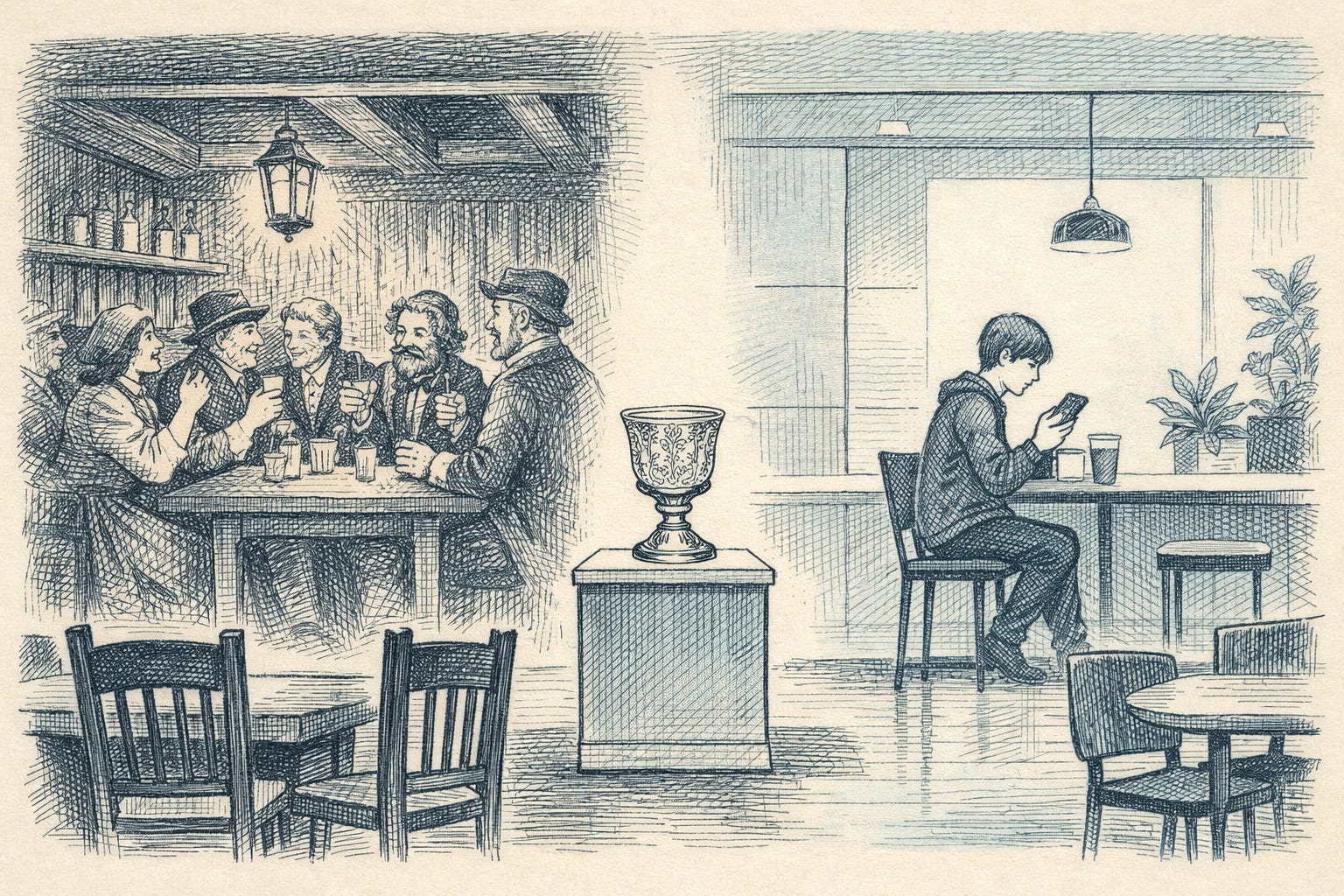
I was reading the latest news from the alcohol industry the other day, and the level of panic could power a small city. Warehouses are overflowing, prices are sliding, young people aren’t drinking. Civilizational collapse, apparently. You’d think this would be good news—less cirrhosis, fewer bar fights, fewer poetic monologues delivered to streetlights at 3 a.m. But no. Economists are tearing their hair out: traditions are dying, generations are changing, demand curves are misbehaving. A tragedy.
And it made me wonder: was alcohol really the universal measuring stick of adulthood for our generation? The milestones of life weren’t marked by diplomas or weddings, but by the transition from beer to whiskey, from cheap fortified wine to “respectable” cognac. If that was the ladder, what happens when the next generation declines to climb it?
From Eyeliner Powder to the “Spirit of Wine”
Let’s start with etymology, because half of history hides in words. The word “alcohol” comes from the Arabic al-kuḥl, a fine powder used as eyeliner—antimony dust Egyptian women applied to create dramatic, smoky eyes. Medieval alchemists later used the term for the purified “essence” extracted through distillation. Eventually, the eyeliner became the “spirit of wine,” and then the name for an entire class of chemical compounds.
There’s something poetic about it. A substance once used to enhance beauty ended up synonymous with its destruction. History does enjoy a good plot twist.
As for Russian drinking culture, legend has it that in the late 10th century, Prince Vladimir rejected Islam with the words: “Drinking is the joy of Rus.” Whether he actually said it is debatable, but the quote embedded itself so deeply in the cultural code that it hardly matters. Catherine the Great is often credited with saying, “It is easier to rule a drunken people”—a line historians can’t confirm. But again, it survives because it sounds plausible.
By the 19th century, alcohol taxes accounted for roughly 40% of the Russian Empire’s revenue. The state was effectively the largest dealer in the land, except the product was legal and socially endorsed. Ivan the Terrible opened taverns across the country in the 16th century, and by 1648, a third of working men were reportedly in debt to them. Peter the Great even used tavern debt as a recruitment mechanism for the army. Logistics, imperial edition.
The Soviet Sobriety Experiment
The USSR tried to fight drinking in bursts of enthusiasm followed by fiscal regret. The Bolsheviks initially imposed prohibition—they needed sober, productive proletarians. By the 1920s, however, vodka was back. The New Economic Policy had rediscovered a timeless truth: budgets don’t balance themselves.
By the 1970s, alcohol taxes again made up roughly a third of state revenue. The government was simultaneously campaigning against alcoholism and relying on it to pay the bills. It was a masterclass in circular dependency.
Gorbachev’s 1985 anti-alcohol campaign was the most ambitious attempt at mass sobriety. Vineyards were destroyed, production slashed, fines imposed. For a while, it worked: consumption dropped, life expectancy rose, crime declined. But the fiscal losses were enormous. In 1989 alone, the budget reportedly lost nearly 92 billion rubles out of 459 billion in total annual revenue—close to one-fifth of the state’s income. (Estimates vary, but the damage was undeniable.)
Predictably, people turned to homebrewing and industrial substitutes. The state lost money, citizens lost their livers, and after the Soviet collapse, alcohol consumption surged. In the early 2000s, Russians were drinking around 11–12 liters of pure alcohol per capita annually—among the highest rates in the world.
For the Soviet citizen, alcohol wasn’t just a beverage. It was ritual, therapy, networking, punctuation. Vodka was listed under “hot beverages” in restaurants—a subtle wink. Toasts were mandatory. Champagne, once a symbol of aristocratic decadence, became accessible to everyone, transforming into the default accessory of celebration.
For those of us who grew up in the 1980s and 1990s, alcohol really did function as a status marker. The first sip of beer was a rite of passage. An expensive cognac in a dimly lit bar signaled success. A glass of wine on a date was social lubricant in liquid form. The bar was the arena of introductions. Drinking was how you decompressed after work, processed heartbreak, and occasionally made questionable life decisions.
The Sober TikTok Generation
Now enter Gen Z, born roughly between 1997 and 2012. The numbers are quietly revolutionary. In 2023, about 62% of Americans under 35 reported drinking alcohol, compared with roughly 72% in the early 2000s—a noticeable decline. Among college students, the share of non-drinkers has risen over the past two decades. Studies consistently show that Gen Z drinks less on average than millennials did at the same age.
Industry data reflects the anxiety. Younger consumers account for a disproportionately small share of alcohol purchases compared with Gen X, millennials, and boomers. Meanwhile, the non-alcoholic beverage market has grown rapidly in recent years, while growth in traditional categories has slowed or stagnated.
Why?
Health is the new religion. Gen Z grew up with instant access to medical research, infographics, and public health campaigns. They know alcohol is a carcinogen. They know it’s a depressant. They know it’s associated with over 100,000 deaths annually in the U.S. alone. Advisory bodies in recent years have recommended clearer cancer warnings on labels. For a generation that treats mental health as non-negotiable, willingly consuming a substance that worsens anxiety and depression feels… inefficient. Instead of drowning sorrows, they schedule therapy—or message a chatbot.
Then there’s economics. Gen Z entered adulthood amid rising housing costs, student debt, and wage stagnation. Bars are expensive. Craft cocktails even more so. When rent consumes half your paycheck, artisanal gin loses its charm.
They also have alternatives. Our generation had television, books, maybe a few hobbies. Gen Z has streaming platforms, gaming ecosystems, endless social feeds, podcasts, immersive digital worlds. Relaxation has gone multi-platform. The liver is no longer required.
Socialization itself has shifted. Time spent hanging out in person has declined over the past two decades, especially among younger cohorts. Much interaction happens online. And in digital space, intoxication is optional—and potentially disastrous.
Which brings us to reputation. Gen Z grew up under permanent surveillance. One drunken video, one ill-advised post, and your career prospects can evaporate. When everything is archived, sobriety is strategic.
Status symbols have changed too. An overpriced bottle of scotch doesn’t impress like it used to. Today’s signals are ethical consumption, sustainability, wellness routines, vintage thrift finds, maybe an overpriced organic smoothie. Prestige has been rebranded as responsibility.
The End of an Era—or Just a Pause?
Does this mean alcohol culture is finished? Probably not. Some research suggests that as incomes rise, drinking patterns may shift upward too. Cycles happen. But something deeper has changed. Alcohol is no longer the default metric of adulthood. It’s an option among many—and not necessarily the most glamorous one.
There’s a quiet irony here. The generation often accused of immaturity may have adopted a more mature stance toward alcohol than their parents. Instead of numbing stress, they analyze it. Instead of ritual intoxication, they experiment with optimization.
Maybe Gen Z didn’t “forget how to drink.” Maybe previous generations never learned how to live without it.
Alcohol isn’t demon or cure. It’s a tool. The Soviet state tried banning the tool—failure. Modern youth simply reached for a different toolbox.
History suggests heavy drinking isn’t destiny; it’s context. When governments build budgets around alcohol sales and then declare war on alcoholism, contradictions are inevitable. Now that a generation is quietly stepping away from that model, the industry calls it crisis.
Perhaps the real question isn’t why they’re drinking less. Perhaps it’s why we needed it so much.
Farewell, shot glass. It was fun—right up until it wasn’t.
And yes, in case you’re wondering, this essay about sobriety was generated by an AI. Completely sober, naturally.