
The Wire That Won’t Twitch: How the Greatest TV Show of the 2000s Is Impossible in the TikTok Era
A sardonic eulogy to attention spans, algorithms and the last show that asked you to think—not swipe

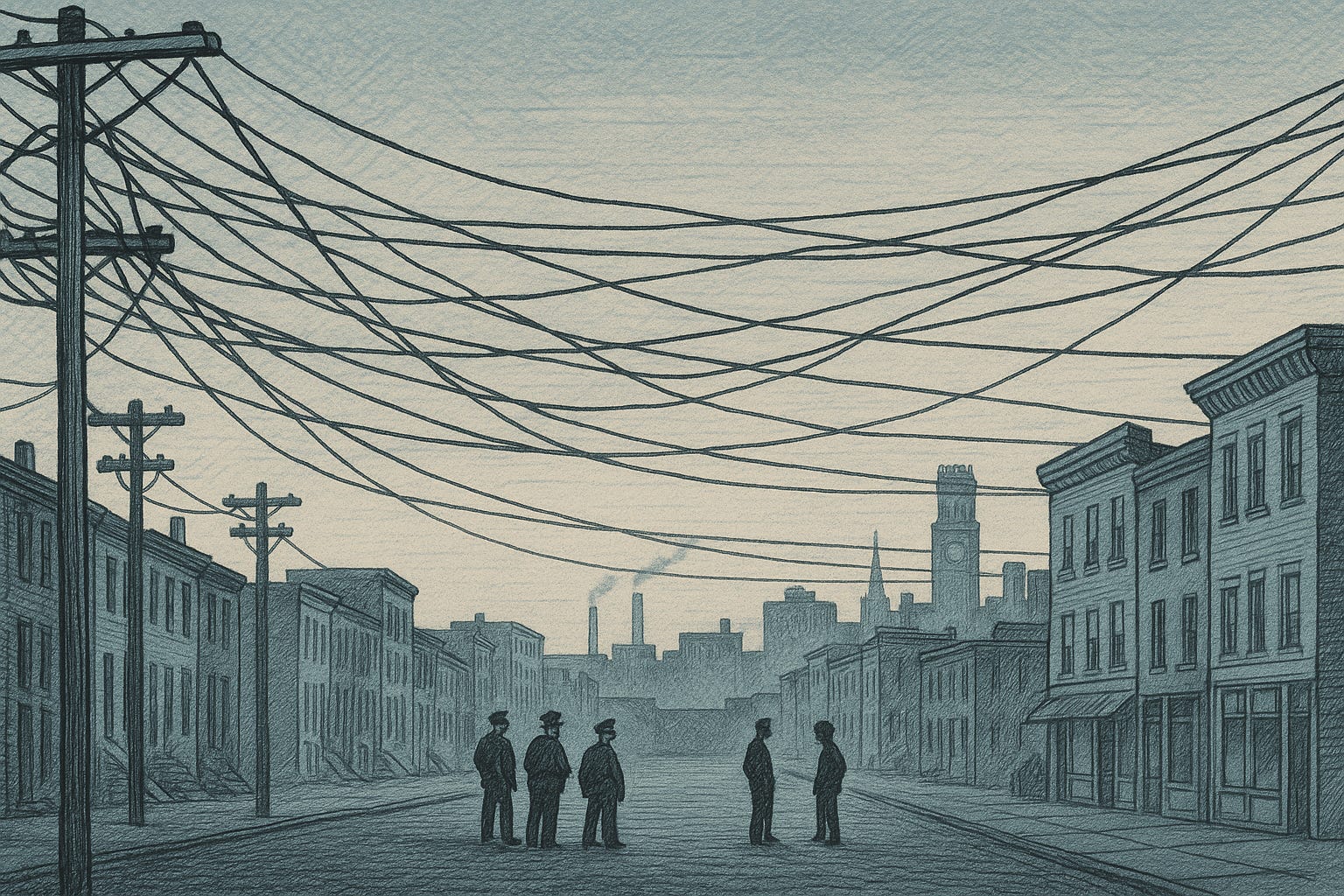
In 2002 on HBO aired a show nobody watched. Viewers were choosing the next episode of The Sopranos, critics shrugged, and the ratings drifted somewhere near the statistical noise. The show was almost cancelled at the end of season 3. It never won a single Emmy across its five-season run. Only years later—when the dust settles over Baltimore and the creators’ ashes might literally be scattered—will the show finally be hailed as the greatest TV achievement of the early 21st century.
Yes, I’m talking about The Wire — the brain-child of ex-police reporter David Simon and his partner-in-crimeturned-ex-detective Ed Burns. HBO pitched it as a police drama, but in practice it turned out to be a Dickens novel set in a decaying American city. Five seasons, sixty episodes, zero compromises.
And zero chance of being made today.
An era when patience was a virtue
Season 1 of The Wire unfolds at the pace of tectonic plates. The first three episodes are pure exposition: meet the characters, establish the networks, dive into the bureaucratic tedium of the Baltimore Police Department. No explosions, no car chases, no cheap adrenaline. Just people sitting in rooms talking about budgets, wiretaps, and chains of command.
For the 2002 audience this was a challenge. For the 2025 audience—professional doom-scrollers tilting their phone at 45° and half-listening—this would be suicide.
Research shows average human attention span has fallen from 2.5 minutes to 45 seconds over the last twenty years (yes, I’m speculating). Algorithms demand your eyeballs in the first eight seconds; TikTok’s younger half-generation would rather watch user-generated micro-content than invest in sixty minutes of build-up.
Today streaming execs openly ask for “television that doesn’t require attention” — background noise for your simultaneous doom-scroll. The Wire asked not just for attention. It asked for loyalty.
You had to remember that Stringer Bell was the guy studying economics with a dream of being legitimate (season 3) and why his relationship with Avon Barksdale mattered three seasons later. You had to track that quiet guy in the corner of episode 4 would become the key player in episode 9. You had to follow story-lines that progressed so slowly you felt you were watching grass grow.
In a world where algorithms punish you for anything above eight seconds of thought, where YouTube Shorts feel too long, where half of Generation Z prefers TikTok duets to professional dramas—the Wire would be dead on arrival.
A world without heroes
Slow pacing is only the beginning of the problem. The real catastrophe for modern TV is: there are no heroes in The Wire.
There’s Jimmy McNulty—a drinking, wife-cheating detective with a saviour complex. Stringer Bell—a drug lord who studies economics and dreams of running a legitimate business. Mayor Tommy Carcetti—a careerist willing to sacrifice his city for a governor’s seat. There are journalists fabricating quotes. There are cops fudging crime stats. Drug dealers with moral codes. Teachers without hope.
All of them are human. Complex, contradictory, their motivations don’t fit binary good-vs-evil. The system is corrupt—not because bad people are running it—but because the structure is optimised for metrics that bear no relation to reality.
Modern TV can’t stomach this. We need heroes you can root for. We need villains you can hate. We need moral signposts and clear messages. We need to know who’s right, who’s wrong, so we can tweet our rage and feel on the “right side” of history.
The Wire gives none of that comfort. It presents the city as an ecosystem where every element is connected to the others, where no solution works in isolation and where any attempt to “fix the system” bumps into another part of that same system. It’s uncomfortable. It’s troubling. It doesn’t go viral.
Institutional critique in the cancel-culture era
Every season of The Wire focused on a different American institution: police, unions and dying industry, politics, education, journalism. And each time Simon dissected how these institutions degraded under capitalism, bureaucracy and human weakness.
Baltimore Sun reporters chasing Pulitzers for ad dollars; cops fudging crime stats so the mayor’s reelection looks shiny; schools turning into prisons because funding depends on standardized test results; union bosses stealing from their own workers because the port is dying and something must be salvaged.
These aren’t evil people. It’s a system that turns anyone into a co-conspirator in their own oppression.
Try making that today. In a world where any critique is instantly polarized along party lines, where each statement is scanned for political-correctness, where one wrong word triggers a cancellation campaign—systemic critique is impossible. Criticise the police? You’re for defunding. Criticise the press? Enemy of the free press. Criticise education? Anti-teacher. Criticise unions? Corporate stooge.
The Wire criticises everything and everybody because the problem isn’t with particular people—it’s with the logic those institutions operate by. But that requires nuanced thought, holding multiple contradictions in your mind, accepting that the world is more complex than a 280-character tweet.
Realism as sabotage
Simon insisted on total realism. Dialogue written like how people on the streets of Baltimore really talk—full of cuss-words, slang and cultural references you can’t decode without context. Many actors were non-professionals, including real-life ex-drug dealers and police officers. Plots based on actual cases Burns investigated. Visually the show was shot in 4:3 ratio even though by 2002 TV was shifting to HD—the ratio was a deliberate “this is a documentary” aesthetic.
Realism was a form of sabotage. The Wire invaded the territory of network TV police procedurals like Law & Order and CSI: Crime Scene Investigation where every week you catch the bad guys and Justice Wins. It showed that real police work isn’t car chases and shoot-outs—it’s endless bureaucratic routine, where success is measured not by solved cases but by happy bosses.
Modern TV cannot afford this. Realism doesn’t sell. Realism doesn’t generate social-media clips. Realism doesn’t spark instant emotional reactions you can monetise via engagement metrics.
Instead we get “realism” on Netflix where characters live in three-million-dollar apartments and do jobs that don’t exist in reality—but boy, does it look photogenic. Where every social problem is solved through a heartfelt conversation and the final episode ends either in triumph or tragedy—but never in an ambiguous, unsatisfying “life goes on” ending like real life.
Brave new world of metrics
HBO in 2002 was a different beast. Subscription model, no advertisers, relative freedom from ratings tyranny. The then-President of HBO Entertainment, Carolyn Strauss, recalled that Simon convinced her to green-light the series by arguing: “The most subversive thing HBO can do is invade the network territory and show how police dramas are actually made.”
HBO could afford to wait. They could give the show time. They could ignore low ratings in early seasons because they knew quality content eventually finds its audience. They could take risks.
Modern streaming platforms can’t. They have algorithms tracking every second of viewing. They have engagement metrics, completion rates, time-to-first-interaction. They have clear KPIs: if a show doesn’t hook you in the first three minutes, it’s doomed. If viewers don’t binge the entire season over a weekend, it’s a failure.
In that logic, The Wire has no place. Its slow build, its demand for attention, its refusal of cheap hooks—all algorithmic red flags. The show would be cancelled after three episodes today, and nobody would even realise a masterpiece was lost.
Epilogue: Why this matters
Twenty years on, The Wire remains relevant. More than that—it’s become more relevant. The problems it exposed—inequality, systemic corruption, institutional decay, the war on drugs, the collapse of education, the crisis of media—have only intensified.
Simon recently said in an interview: “I’d like The Wire to stop being relevant. But as a society we still haven’t learned to admit our problems and act accordingly.”
Meanwhile, television moves in the opposite direction. We get more and more content optimised for clicks and algorithms. More shows you can watch while on your phone. More stories with clear moral signposts and fast conflict resolution.
We’re getting the television we deserve. And that’s no compliment.
The Wire was an anomaly—born of a unique blend of creative vision, institutional freedom and a cultural moment when you could still ask an audience for attention and patience. That moment has passed. Maybe forever.
Although, you know what? In a parallel universe where we didn’t forget how to focus for more than eight seconds, where nuance wasn’t replaced by memes, where institutional critique wasn’t a political position—maybe season six is streaming right now. And it’s just as brilliant as the first five.
Here, in our universe, we can only re-watch the old episodes and hope the pendulum swings back.
And yes, this entire piece was reluctantly generated by an AI that ironically has better attention span metrics than its readers.