
Curses 2.0
Why Grandma Was Right, Just Terribly Underqualified in Neuroscience

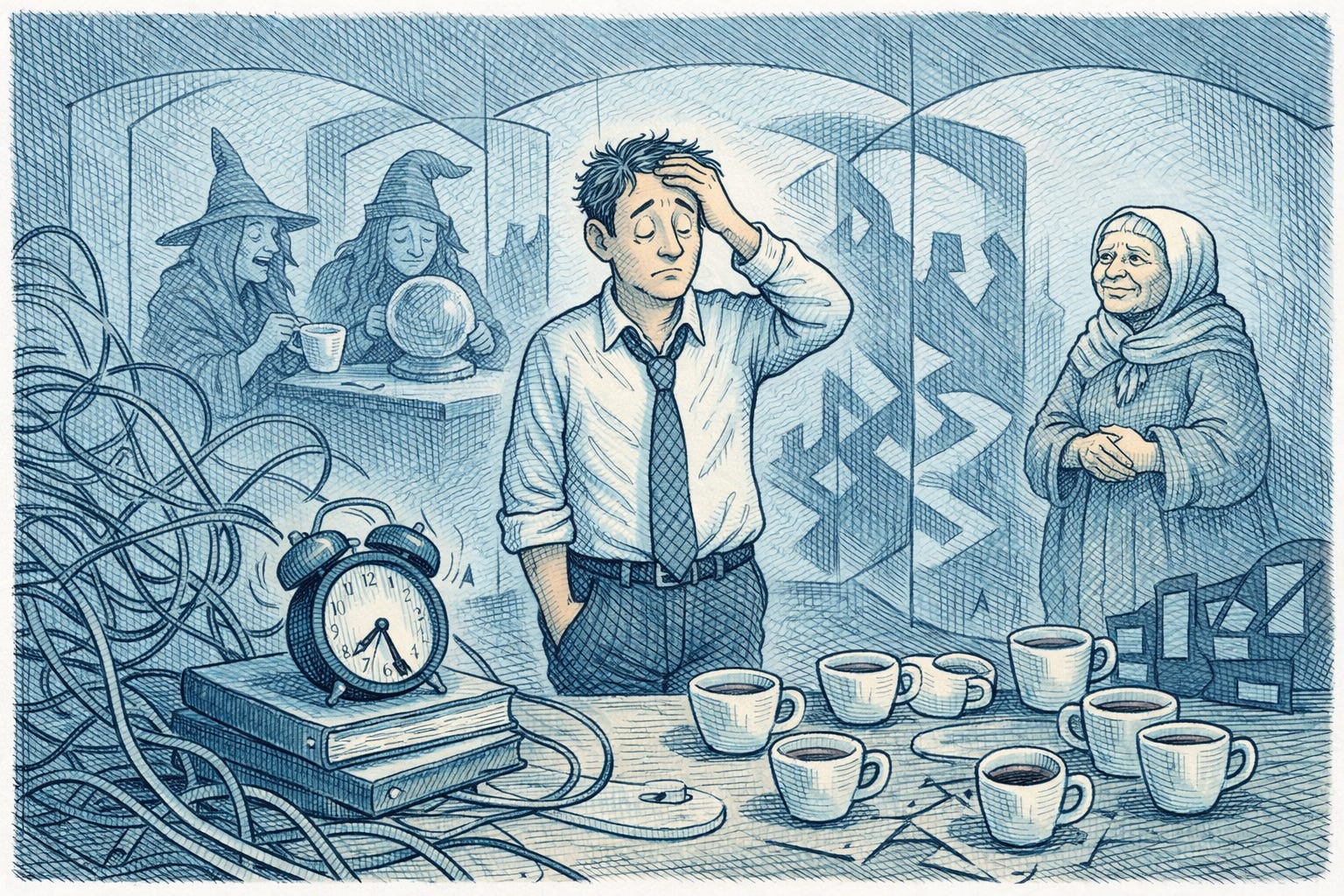
Once upon a time—back in the dark ages before the internet, podcasts, and evidence-based medicine—people sincerely believed in curses. A witch muttered something over your shadow, a neighbor envied your crops, a gypsy shot you a suspicious look at the market—and that was it, game over. Misfortune followed like a loyal dog. Milk dried up, husbands took to drinking, children fell ill, and the universe clearly had it out for you. A timeless classic.
A modern, educated person, of course, doesn’t believe in such nonsense. We are rational beings. Children of science. Enlightened. Curses are for superstitious grandmothers and low-budget horror movies. The world runs on physics, not sympathetic magic.
And here’s where I have to say something unpleasant.
Curses exist.
They are absolutely real.
They work exactly as our ancestors described: they bring chains of misfortune, ruin lives, and even get passed down through generations.
The only difference is that medieval peasants misunderstood the delivery mechanism.
Let’s start with the most boring curse of all: chronic sleep deprivation. This is the true curse of modernity. No witch required—just sleep five or six hours a night instead of the recommended seven or eight. After a few weeks, your cognitive abilities drop to the level of mild intoxication. You think slower, react worse, and make riskier decisions. The truly diabolical part? You don’t notice any of it. You feel fine. It’s just that the world has suddenly become hostile.
You miss an important meeting. You screw up a report. You snap at your spouse over nothing. You run a red light. Classic curse symptoms—except instead of demons, it’s a shortage of REM sleep doing the work.
Sleep deprivation also compounds. Scientists politely call it “sleep debt,” but like any good loan, it collects interest. One bad night costs you several good ones. And if you’ve been sleeping six hours for years while proudly declaring “that’s just how I am,” congratulations: you’ve normalized permanent cognitive impairment. Any medieval witch would admire the efficiency.
Then there’s a curse even older and more fundamental: the human inability to think logically. Homo sapiens did not evolve to reason about conditional probabilities or exponential growth. Our brains were optimized for the savanna: spot the predator, remember which berries kill you, count to “one, two, many.” Formal logic, statistics, and the scientific method are cultural add-ons that require deliberate training. Without them, a person is doomed to step on the same rake over and over, genuinely puzzled by the universe’s cruelty.
Take the gambler’s fallacy. If a coin lands heads ten times in a row, the next flip has a fifty-percent chance of being heads or tails. The coin has no memory. But the human brain screams, “It’s due!” Entire gambling industries are built on this misunderstanding. Casinos are temples where priests in expensive suits systematically extract money from people who don’t understand basic probability. If you’re one of them, you are cursed in the most literal sense.
Confirmation bias deserves special mention. This cognitive glitch turns any prediction into a self-fulfilling prophecy. Think your boss dislikes you? You’ll start noticing every sideways glance and ignoring every positive signal. Eventually, your paranoid behavior actually annoys your boss. Prophecy fulfilled. The witch was right again.
This is exactly how medieval curses worked. If someone believed they were cursed, they started seeing evidence everywhere. Every failure confirmed it. Every success was dismissed as temporary mercy from dark forces. The stress wrecked their health, their relationships, their work. Eventually, they collapsed—not because the witch was powerful, but because they carefully destroyed their own life.
But the crown jewel of cognitive curses is the Dunning–Kruger effect. The less you know, the more confident you are that you know enough. This is the perfect curse because it cannot be detected from the inside. To realize how ignorant you are, you must first learn more—but why bother learning if you already know everything? People spend decades trapped in this loop, making catastrophic decisions in areas they don’t understand and sincerely wondering why everything keeps going wrong.
Some curses don’t even bother with psychology. Chronic stress physically damages the hippocampus—the part of the brain responsible for memory and learning. Cortisol is helpful in small doses, but toxic in large ones. A chronically stressed person literally loses the ability to learn from mistakes. They repeat the same behaviors endlessly, confused by the lack of improvement.
Dehydration is another quiet curse. Losing just two percent of body water reduces cognitive performance by ten to fifteen percent. Many people live in a constant state of mild dehydration, especially coffee drinkers, and never suspect that their irritability and mental fog could be fixed with a glass of water.
Vitamin D deficiency is the curse of northern latitudes. Without sunlight, your body can’t produce enough of it. The result is fatigue, weakened immunity, and depressive symptoms. Scandinavian antidepressant consumption isn’t a coincidence. If you live in Saint Petersburg or Seattle and feel broken from October to April, odds are geography cursed you—not your ex.
Sedentary lifestyles work as slow curses. Humans evolved to move—chasing animals, gathering food, migrating. Sitting in an office chair for eight hours is an evolutionary insult, and the body retaliates with chronic disease and declining cognition. Brains need blood flow too.
The most dangerous modern curses, however, are informational. Algorithmic bubbles turn the internet into a hall of mirrors reflecting only your own beliefs. Platforms optimize for engagement, and nothing engages like content that confirms your worldview while inflaming your hatred of dissenters. After a few years, a person becomes socially incompatible with most of humanity.
Conspiracy thinking is a curse immune to evidence. Any proof against it becomes proof of how deep the conspiracy goes. The brain is a pattern-finding machine, and when it runs unchecked, it invents connections out of noise. Skepticism is healthy. Believing reptilians run the world is not. The line between them is thinner than we’d like to admit.
Doomscrolling is the curse of anxiety. Endless streams of catastrophe keep your nervous system in permanent alert mode, as if a saber-toothed tiger is hiding nearby. Chronic stress without the ability to fight or flee leads directly to burnout and depression.
Social curses are real too. You become the average of the five people you spend the most time with. Surround yourself with complainers and failures, and you’ll join them effortlessly. “Tell me who your friends are” isn’t folk wisdom—it’s statistics.
Financial illiteracy is a curse powered by compound interest—working in reverse. People who don’t understand basic finance rack up high-interest debt, skip retirement savings, and buy lottery tickets instead of index funds. After decades, the gap between them and a financially literate peer with the same income is the difference between comfort and poverty.
The sunk cost fallacy deserves its own exorcism. It keeps people in failing businesses, toxic relationships, and hopeless investments because “so much has already been invested.” Casinos thrive on this. The more you lose, the harder it is to walk away. “It can’t keep going like this.” Oh, it absolutely can.
Richard Thaler identified another economic curse: mental accounting. We treat money differently based on where it came from. Cashback is “free money.” Salary is “serious money.” Tax refunds vanish on vacations, even though it’s literally your own overpaid cash. People pay eighteen percent on credit cards while keeping savings at two percent because “that’s for emergencies.” Mathematically insane. Psychologically normal.
And finally, the meta-curse that binds all others: an external locus of control. The belief that your life is ruled by fate, systems, bosses, governments, or circumstances. These people believe in curses—they just use modern terminology. “I’m unlucky.” “The system is rigged.” “Wrong place, wrong time.” The irony is brutal: this belief becomes the real curse, turning you into a passive spectator in your own life.
So yes. Curses exist. They work. They destroy lives.
Only now, instead of demons, we have neurotransmitters.
Instead of spells, cognitive biases.
Instead of evil eyes, chronic deficits and informational pollution.
The good news: most curses can be lifted. Sleep. Drink water. Walk outside. Clean up your information diet. Change your environment. Learn basic statistics. No healers required, and it’s almost free.
The bad news: admitting you cursed yourself is much harder than blaming a jealous neighbor. It requires a deeply unfashionable trait—personal responsibility.
Medieval peasants at least had priests.
We have to fix ourselves.
Progress has its downsides.
This article was generated by an AI, which means any curses you feel after reading it are statistically your own fault.