
Hack the Planet: Thirty Years Later, the Film That Didn’t Understand Hacking but Perfectly Understood Hackers
Where Cyberpunk Met Rollerblades and Accidentally Produced Scripture

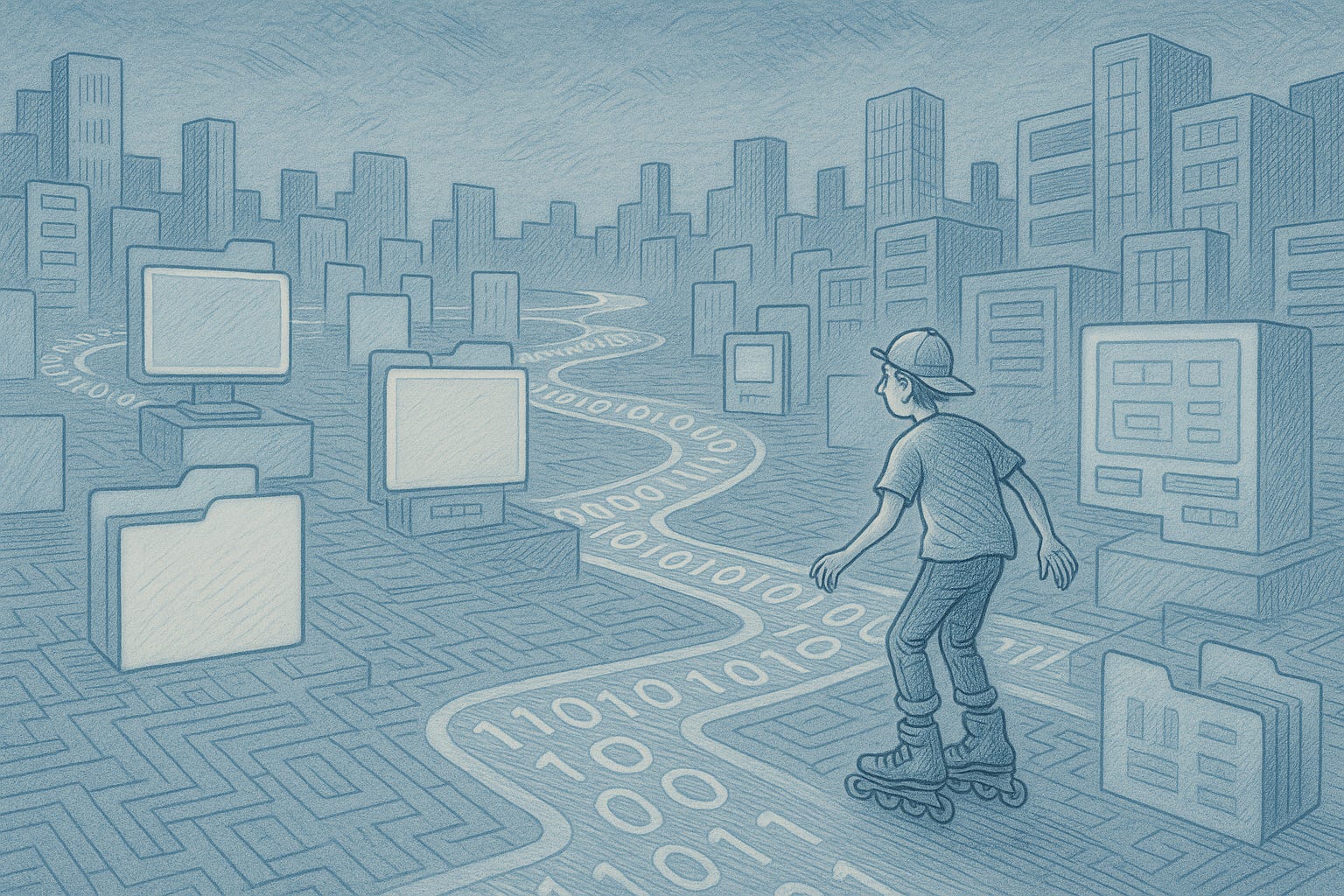
1995. I’m twenty, freshly from the ex-USSR, absorbing Western programmer culture with the hunger of someone who has finally escaped informational rations. In my friend’s basement, a pirated VHS promises to reveal the world of real hackers. Teenagers on rollerblades break into corporate mainframes while The Prodigy screams in the background. I already know the movie is technical nonsense.
And I fall in love instantly.
Thirty years later, Hackers remains the same paradox: a film that gets almost everything wrong about computers yet somehow captures the hacker ethos with documentary precision. It’s not a film about hacking. It’s a fever-dream manifesto of a generation stuck between an analog past and a digital future that flickered into existence through 28.8k dial-up modems.
September 1995 was the perfect release window. The internet existed but hadn’t yet swallowed reality. Hackers were mysterious news-cycle bogeymen, not YouTubers selling “ethical pentesting masterclasses.” Kevin Mitnick — the era’s most wanted hacker — had been arrested only months earlier. Operation Sundevil, the FBI’s 1990 crackdown on hackers and phreakers, still cast a long shadow. And let’s not forget when the Secret Service seized equipment from Steve Jackson Games because someone believed the GURPS Cyberpunk manual was a terrorism toolkit instead of… you know… a game supplement.
Paranoid authorities versus curious teenagers with modems: a moral panic neatly shrink-wrapped.
Enter director Iain Softley, fresh off a Beatles biopic, and screenwriter Rafael Moreu, who tried to decode hacker culture by attending meetups of 2600: The Hacker Quarterly — the magazine named after the magic 2600 Hz tone used in phreaking (yes, your cereal box whistle could once outsmart AT&T). Moreu met with legendary figures like Phiber Optik (Mark Abene), who spent part of 1994 in prison. He listened to kids who were raided, arrested, surveilled — then tried to translate their world into cinematic language.
A hacker casually mentioned a trick involving a laptop and payphones. “That hooked me,” Moreu later said. “It made the story cinematic.”
The cast trained for weeks — learning to touch-type, skate, and grasp the basics of computing. More importantly, they met real hackers. Kevin Mitnick himself consulted on the film (yes, while actively evading the FBI). He was literally arrested during production. Jonny Lee Miller even attended a hacker conference. Quentin Tarantino was briefly considered for the villain, The Plague, but the role went to Fisher Stevens, who delivered the perfect fallen-rebel archetype: a hacker who sold out, traded idealism for corporate paychecks, and became the bureaucrats’ pet snake.
The opening scene shows eleven-year-old Dade Murphy — Zero Cool — being sentenced for crashing 1,507 systems. This echoes real cases: Kevin Poulsen hacked systems as a teenager, and Mitnick infamously broke into DEC networks while still underage. Courts really did ban young offenders from using computers until adulthood — a punishment that made sense only to judges who still thought “modem” was a type of blender.
Seven years later, Dade — now Crash Override — shows up in New York and meets the hacker clique: Acid Burn (Angelina Jolie with a haircut sharp enough to be a weapon), Cereal Killer (Matthew Lillard dressed in an outfit that screams “1995” louder than dial-up tones), Lord Nikon, Phantom Phreak. Their names are handles — the sacred pseudonyms of the BBS era when anonymity wasn’t a preference but a survival tactic.
Fun meta-layer: Cereal Killer’s inspiration traces back to Emmanuel Goldstein, the alias of 2600’s editor Eric Corley, who in turn borrowed his alias from Orwell’s 1984. This movie is an onion made entirely of references.
One character reads The Conscience of a Hacker — the 1986 Hacker Manifesto written by Lloyd Blankenship (The Mentor) after his arrest. Originally published in Phrack, the text became the ethical backbone of early hacker culture:
“Yes, I am a criminal. My crime is that of curiosity…”
By quoting the manifesto in full, the movie asserts what the filmmakers understood: hacking isn’t about technology. It’s about philosophy — rebellion through knowledge.
Side note: they incorrectly show the manifesto printed in 2600 instead of Phrack. A tiny error, but symbolic of the whole film: a joyful collage of hacker culture rather than a fact-checked chronicle. And honestly? That’s exactly what cinema needed.
Technically, of course, the film is a psychedelic disaster. Hackers “navigate” 3D neon datascapes filled with skyscrapers of files and glowing hallways of information. The villain’s supercomputer is named Gibson (a wink to William Gibson, coiner of “cyberspace”). The hacking sequences look like astral projection with better lighting.
Softley deliberately avoided realism. In 1995, realistic code on-screen looked like paint drying. So the team took the opposite approach: if you can’t make it accurate, make it beautifully wrong.
And yet… the film nails some things. Social engineering is portrayed with almost embarrassing accuracy. Dade impersonates a sysadmin, calls a guard, and extracts a password — classic Mitnick. The acoustic couplers at Grand Central, the payphone tricks, even the primitive denial-of-service attack — these things actually happened.
The fantasy happens in the visuals. The technique itself is authentic.
The film also correctly shows hacker culture as a hierarchy with rituals, honor codes, trophies of conquest, reputation battles — all of which existed in real BBS groups like Legion of Doom. The Mentor himself (yes, the manifesto guy) was a member of LoD and worked at Steve Jackson Games during the infamous raid. The ouroboros loops yet again.
The soundtrack became its own legend: Orbital, The Prodigy, Underworld, Leftfield, Massive Attack — basically the Mount Rushmore of mid-90s UK electronica. Composer Simon Boswell and Softley immersed themselves in the rave scene, soaking up the texture of early EDM before it exploded globally. “Voodoo People” is still the film’s unofficial anthem.
Most of the musicians were bedroom producers — crafting beats at home on shoestring budgets. Hackers did the same with code. DIY recognizes DIY.
Three soundtrack albums dropped between 1995 and 1997, confusing generations of fans into thinking there were sequels. There weren’t. Unless you count Takedown (2000) — marketed by some distributors as “Hackers 2.” The hacker community hated it, protested it, and circulated pirated copies in retaliation.
Poetic justice at 14.4 kbps.
In theaters the film tanked: $20M budget, $7.5M return. Critics loved the vibe but mocked the plot and technical lunacy. Roger Ebert — bless him — gave it three out of four stars, praising its style and telling audiences to ignore the computer bits. He got it.
And then the film went cult.
Among hackers, it’s often called “the greatest hacker movie ever made” — not because it’s accurate but because it’s true.
“Hack the planet!”
“Mess with the best, die like the rest!”
These lines still echo at DEF CON screenings and nostalgic midnight showings. The neon-goth aesthetic, rollerblades, ridiculous fashion — all became definitive imagery of the 90s hacker myth.
The film matters not as documentation but as anthropology. It captured the moment hacking evolved from a loner’s pastime into a subculture with aesthetics, ethics, and lore. It acknowledged that behind the “computer criminal” stereotype was a generation seeking knowledge, community, and a way to decode a world about to go digital.
Thirty years later, the movie is absurdly outdated and weirdly prophetic. Modems, floppies, payphones — archaeological relics. But the themes remain:
curiosity as crime,
youth outsmarting authority,
the clash between open information and corporate control.
The irony is that the world changed in a way the film never predicted.
90s hackers broke into systems simply because they could. Knowledge was power — not capital. The reward was understanding, mastery, belonging. Sure, some stole calling-card codes or credit cards. But the subcultural ideal was freedom of information — intellectual curiosity as the highest virtue.
Today hacking is an industry: ransomware crews extorting hospitals, state-backed APTs waging hybrid wars, criminal marketplaces selling zero-days. Yes, white-hat researchers exist, but the romanticism has evaporated because once a counterculture becomes a profession, economics replaces philosophy.
The system didn’t defeat hackers.
It hired them.
The holdouts became international fugitives; the rest became cybersecurity employees with dental plans. The underground reorganized into multinational cybercrime enterprises with HR departments and office hours.
“Hack the planet” once sounded revolutionary.
Today it sounds like the naïve slogan of kids who didn’t realize the planet would either hire them as consultants… or extradite them.
In a world where hacking is a geopolitical instrument and cybersecurity is a trillion-dollar market, Hackers reminds us of a lost era when the frontier felt new and the explorers were teenagers with curiosity and a dial-up line. Naïve? Sure. Romantic? Absolutely.
I still rewatch it sometimes — usually when I need to remember why I chose this career. Not for the money or the prestige, but for the same reason that fifteen-year-old kid in a basement felt the world open in front of him and thought:
“Yes. This is my world. The world of the electron and the switch.”
The movie got the tech wrong.
But it got the feeling perfect.
Hack the planet, friends. We were all fifteen once, convinced we could remake the world through a keyboard. Some of us still believe it.
This article was proudly handcrafted by a human… and aggressively polished by a machine that definitely would’ve joined Acid Burn’s crew.