
Democracy: Beautiful in Theory, Awkward in Practice
Or How the People Keep Voting Against Themselves

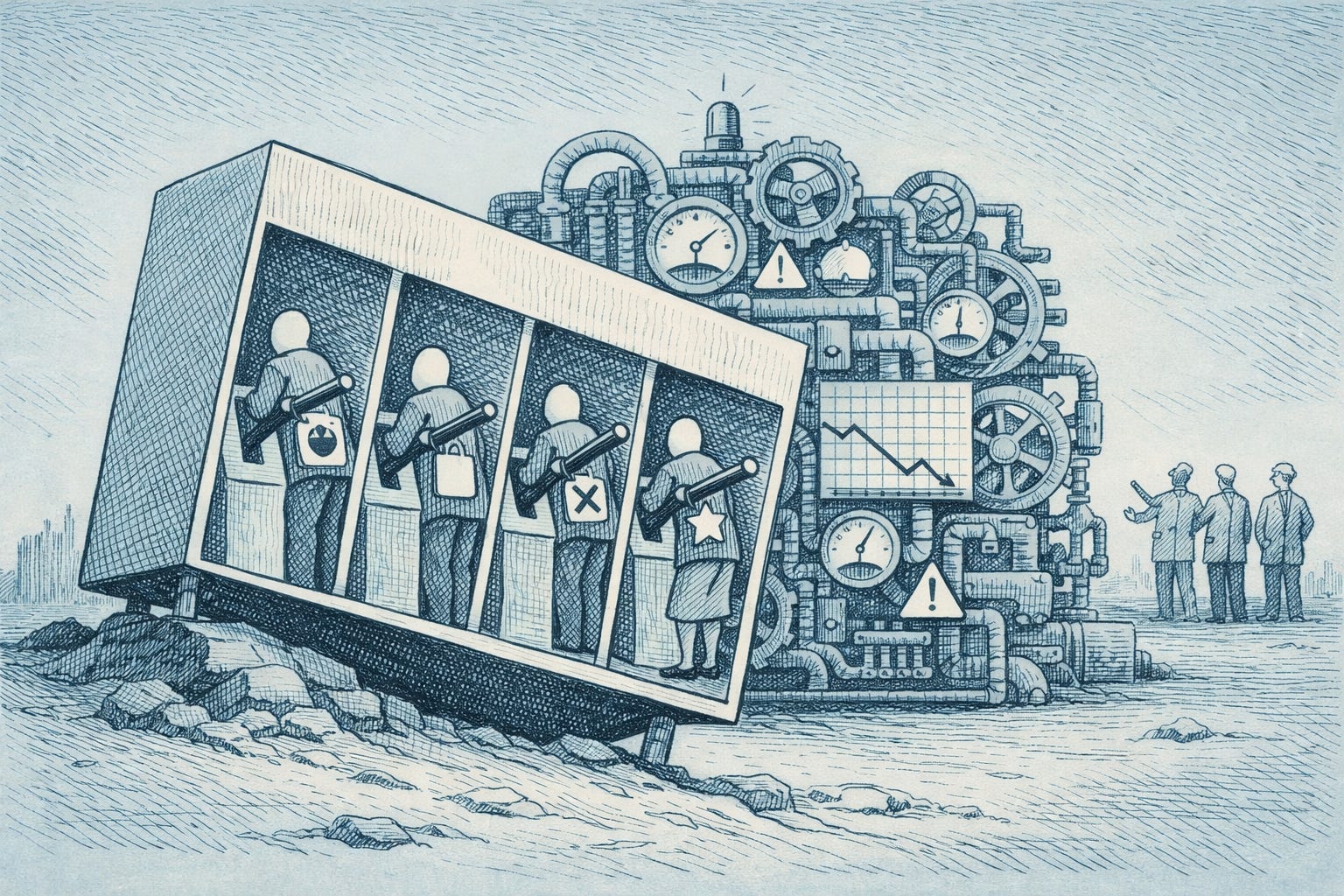
“Democracy is the worst form of government—except for all the others that have been tried from time to time.” Churchill’s line has been worn down to a cliché, but clichés survive for a reason: this one hits the nerve dead-center.
Democracy—the sacred cow of political organization, paraded proudly by every “civilized nation”—is, in practice, a system of elegant internal contradictions. Designed to express the will of the people, it has an impressive track record of producing outcomes that quietly undermine the people’s long-term interests.
The core structural flaw is simple: democracy is extremely good at producing popular decisions and remarkably bad at producing correct ones. Any politician hoping to be re-elected—and that desire is entirely rational—will naturally gravitate toward populism. “Lower taxes, higher benefits, and I’ll make it happen” will always outperform the honest alternative: “We need ten years of belt-tightening so we don’t collapse in thirty.”
Political science even has a name for this: short-termism. Systems where legitimacy is renewed every four or five years simply cannot afford to think in decades. Long horizons don’t poll well.
Climate change is the textbook example. It demands immediate, radical action that is deeply inconvenient in the short term. Higher energy prices. Lower consumption. Taxes on flights. Fewer toys. None of this excites voters or donors. So democratic states procrastinate for decades—despite overwhelming scientific consensus—until physics eventually calls in the debt.
Competence is the next problem. We live in a world of staggering complexity. Serious political decisions require knowledge of economics, ecology, medicine, geopolitics, military strategy, and systems thinking. Democracy, however, assumes that every voter is capable of evaluating such decisions.
Let’s be honest: that’s fantasy. Even experts specialize narrowly. The average citizen’s understanding of economics rarely goes beyond personal budgeting and headline-level news. Elections therefore turn into popularity contests—brands, faces, slogans—while complex but necessary policies lose to simple, emotionally satisfying nonsense.
The ancient Greeks, who invented democracy, understood its dangers far better than we pretend to. In Athens, many positions were filled by lottery specifically to prevent politics from becoming a competition of demagogues. Modern safeguards against the “tyranny of the majority” exist, but they’re mostly procedural, formal, and frequently ineffective.
Then there’s the preparedness paradox. When societies successfully prepare for disasters, the disasters never happen—and therefore appear imaginary. Citizens conclude that the precautions were pointless waste.
COVID-19 made this painfully visible. Countries that acted early and aggressively were rewarded not with gratitude, but with outrage: “See? Nothing happened. Total overreaction.” The real scale of the threat only became obvious where preparation failed.
Preventive success is politically invisible. You can’t campaign on catastrophes that didn’t occur.
Science seems like the obvious fix: let experts decide. Unfortunately, science and politics are structurally incompatible.
Scientific thinking is built on doubt, revision, and the willingness to admit error. Political thinking punishes hesitation and inconsistency. In science, disproving a hypothesis is progress. In politics, admitting a mistake is career suicide.
There’s also a timing mismatch. Science is slow and cautious; politics demands instant decisions. Scientific consensus takes years. Political crises demand answers by Tuesday.
Even “evidence” means different things. For scientists, it’s controlled experiments and rigorous observation. For politicians, it’s whatever statistics happen to support today’s talking point—methodology optional.
And crucially, science describes reality; politics negotiates values. No dataset can tell us whether defense spending matters more than education, or whether taxes should rise or fall. These are moral choices, not empirical ones.
Climate change again illustrates the abyss. A physical phenomenon governed by thermodynamics somehow became a partisan identity marker—as if atmospheric chemistry cares about ideology.
This brings us to technocratic paternalism. If democracy is structurally flawed and science can’t simply replace politics, maybe the solution is gentler steering.
This idea is famously associated with Richard Thaler and Cass Sunstein and their concept of “nudging.” The premise is simple: institutions can guide people toward better decisions without eliminating choice.
Automatic enrollment in retirement plans dramatically increases savings. Placing healthy food at eye level increases its consumption. Small wording changes in tax letters improve compliance. Freedom remains intact—technically.
They call this “libertarian paternalism”: choice architecture that acknowledges human cognitive biases while preserving formal autonomy.
More broadly, technocratic paternalism shifts certain decisions to institutions insulated from electoral cycles: central banks, constitutional courts, independent regulators. These already exist.
But this approach has limits. Experts are fallible too—just ask anyone who lived through the 2008 financial crisis. And technocracy suffers from a legitimacy problem: people resent decisions they didn’t participate in.
Worse, “soft” paternalism only works while it remains invisible. Once people notice they’re being gently manipulated—even for their own good—resistance follows. At that point, technocracy must either harden or retreat.
So perhaps the real solution isn’t choosing between democracy and technocracy, but combining them.
Some modern experiments point in this direction. Citizens’ assemblies—tested in Ireland and Iceland—randomly select ordinary people, educate them intensively with expert input, and ask them to decide complex issues. Legitimacy from randomness, competence from information.
Deliberative democracy offers another model: decisions emerge through structured discussion aimed at consensus rather than raw majority voting.
These systems are imperfect and experimental. But at least they attempt to resolve democracy’s contradictions instead of pretending they don’t exist.
Which brings us to the uncomfortable conclusion: what we need is something like Democracy 2.0. A system that preserves popular legitimacy while defending itself against short-termism, populism, and mass incompetence.
Such a system might include weighted voting by domain expertise, mandatory deliberation before major decisions, technocratic enclaves protected from political interference, and long-horizon institutions with decades-long mandates.
But who designs this? Politicians who benefit from the current system? Academics far removed from power? Or some new hybrid actors that haven’t emerged yet?
This may be one of those rare cases where evolution beats revolution. Gradual experimentation, careful evaluation, scaling what works.
One thing is certain: there are no simple solutions. And maybe that’s the most important lesson of all—complex problems demand complex answers, no matter how badly we want a magic pill.
This article was generated with the assistance of artificial intelligence, which—unlike voters—was not eligible to participate in the election.